CW is dead. Long live CW!
Posted on May 25, 2020 by Larry N8KU
As much as I love CW, having used almost nothing else since 1972, I am finally going to make the call: time of death: July 4th, 2019.
That was the year when I decided to give this special flavor of “digital” a try. The CW segments are going dark. Outside of the “military” countries, hardly anyone knows CW any more. It is now nearly impossible to achieve DXCC/CW on most bands. (Maybe 40 or 10.)
It’s not like I never experimented with digital modes. I was there right at the beginning – in 2001, running PSK like the rest of you. But one of the things that always drove me up a wall with the “new” modes is that they could never quite reach critical mass. Sure, you could sit there and maybe do a worked all states eventually, but DXCC on PSK? Correct me if I am wrong, but I never heard of anyone who actually did that.
With each mode, by the time I had a few countries under my belt, everyone was moving on to something else. I really enjoyed Olivia, and I found a few guys running it I could have a QSO with. A few.
I took a stab at RTTY. It’s a great mode, but it’s age is showing. Terrible software. Way too many settings to fuss with, that no one (not even me – and I used to repair TTY machines!) understands any more.
Then came JT65. That was when digital went sour for me. Oddly enough, there were more people using this than anything that came before it. But I just couldn’t take it. Too S-L-O-W.
But then – when I wasn’t looking, the the tech improved dramatically. Everyone has good, low-latency Internet now…
The best thing about FT8: everyone is actually using it! I mean, just this morning I got Greenland, on 17 meters. Easily. No more waiting for contests, for everyone to turn on their radios. You can find good DX, 24 hours a day, without too much trouble. Even with almost no sunspots or solar flux.. Guys are having fun again!
Is it TOO easy? NO. But if you want to work anything besides Texas, California and Florida, it really does require skill. Like “listening” (oops – I mean watching. And waiting. I don’t even listen to the audio any more.)
Those of us who worked CW DX definitely have a bit of an advantage. That’s because it’s all about timing! (Don’t forget: the first digital mode was CW!)
Stuff happens FAST in FT8. Even faster in FT4 of course. I need to juggle about eight things at once, every fifteen seconds. If you are used to CW pileups, you know about this already. A lot of the same rules apply, too – “never call on his transmit frequency,” “spread out…” etc. Sometimes I find myself accidentally working two stations at once – no problem, the protocol allows for that. Fox/hound, with the DX op doing 3 QSOs at once is more common than ever. No problem, since they are all within the same 3KHz audio envelope. Plenty of room for everyone, although now we are starting to see “alternative” allocations to FT8.
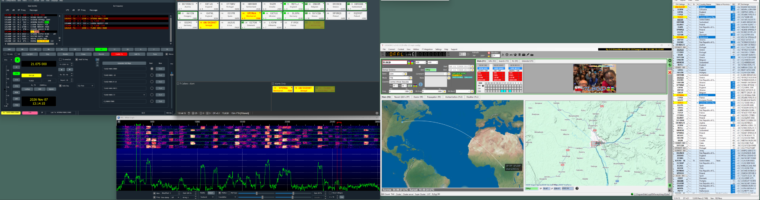
The best part of this (and, to be fair, many other modern digital modes) is that I no longer need to wander up and down the band, listening to each station ID, to see who they are and whether I might want to work them. Now, when I fire up my rig, within seconds I have a display of everyone on the “band.” Thanks to JTAlert, no more looking them up one by one, to see if a KL7 is really in Alaska, or just moved to Texas. And I instantly know if they are a “B4” or not.
It is important to remember that a “sub-band” for FT8 is only as wide as a single SSB conversation. So when propagation is good I can see sixty stations or more at a time.
One of the best and most surprising things to me is that there are so many rare ones on the air routinely. Of course I am only talking “states and countries” (and what exactly is a “country” any more?!) Sure, you will see the usual characters from our (North American) neighborhood, especially Central/South America and the Caribbean… but in just one morning this week, I confirmed Greenland, Lichtenstein, and Mauritania, not to mention more than a few of the tougher states, including Alaska and Hawaii.
No humans involved? No skill required?
Well, all I can say is that there are guys out there (not me!) with nothing but phones, connecting to each other over Internet, without RF – and calling that “ham radio.” And no, cellular doesn’t count. You didn’t build it, don’t own it, and don’t understand RF.
What I mean is, FT8 is nothing like that. It absolutely is radio, bringing together all the best and most important skills that us crazy experimenters have been playing with for the last 100 years. You still need to understand antennas, protocols, and yes – geography – and you will be way ahead if you can write a bit of code.
You could actually make the case that this is a whole other hobby – and in my opinion, it is the perfect one for today’s hams, who usually have loads of experience with computers, networks and digital tech.
This is about my speed – turn on the radio, bring up the computer, check for correct time, check for some “new ones” on whatever band is open. Longer term, I need to stay up to date with WSJTX, JTAlert, and Log4OM. Just remember – keeping a dedicated rig control computer up to date and running smoothly is the key.
Computers are cheap. Don’t try to play around with FT8 on the laptop that you use every day for work, or music, or other important stuff. There are just too many settings that need to be right in order for FT8 to work, and you will find yourself spending hours hunting down what broke it. Dedicate a computer to your radio hobby. Run the FT8 software, maybe JTAlert and a logger, and a few other utilities like a time-sync service. Leave it at that!
Finally, please remember that this is a weak signal, low-power mode. 50 watts is more than enough – and with digital signals, more than that on your average barefoot rig will come close to damaging it. See you on 6 meters!